A solar array produces two things. One is electricity, which is physical and easy to understand. The other is a set of certificates representing the environmental attributes of that electricity, which is abstract, tradable and responsible for a surprising share of project revenue in some markets. Owners who understand only the first half of what they produce are leaving money and compliance obligations unexamined.
What a certificate represents
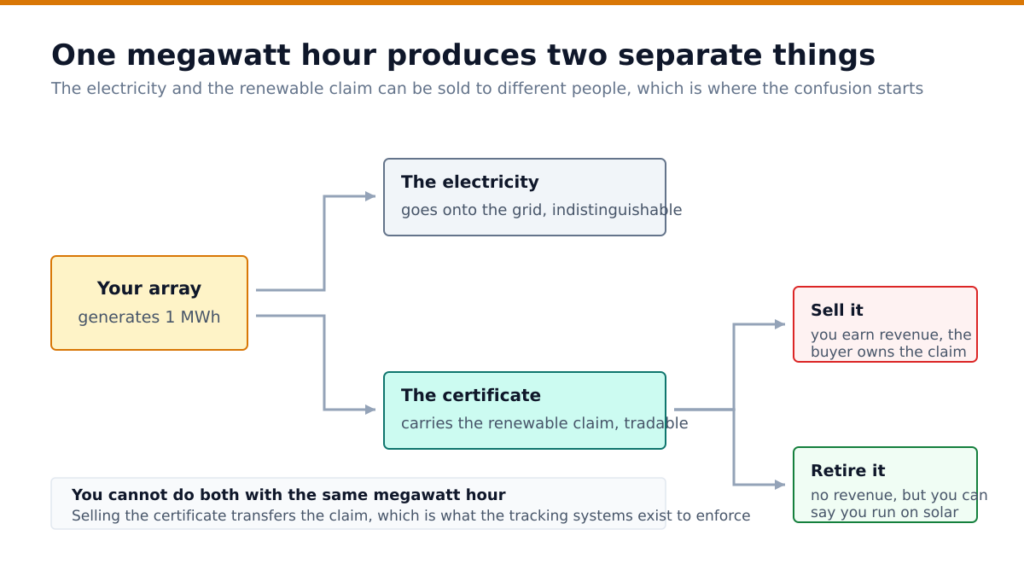
A renewable energy certificate, usually abbreviated to REC, represents the attributes of one megawatt hour of electricity generated from a renewable source. The electricity itself goes onto the grid and becomes indistinguishable from any other electron. The certificate carries the claim that the megawatt hour was generated renewably, and it can be sold separately from the power.
This separation is the key idea and the one that confuses newcomers most. If you generate a megawatt hour and sell the certificate, someone else now owns the renewable claim. You consumed the electricity, but you can no longer say your consumption was renewable, because that attribute has been transferred. If you want to make the claim yourself, you retire the certificate instead of selling it.
Compliance markets and voluntary markets
Certificates trade in two quite different worlds. Compliance markets exist because a state has adopted a renewable portfolio standard requiring electricity suppliers to source a defined share of their supply from renewable generation. Suppliers demonstrate compliance by retiring certificates, and if they fall short they pay a penalty, often called an alternative compliance payment.
That penalty acts as a ceiling on certificate prices, because no supplier will pay more for a certificate than the cost of simply failing to procure it. The floor is set by supply. When generation within a state exceeds what the standard requires, prices fall toward the cost of nothing. When generation lags the requirement, prices rise toward the penalty.
Some states operate a carve out specifically for solar, creating solar renewable energy certificates with their own supply, demand and penalty structure separate from the general pool. Where such a carve out exists and is binding, solar certificates can be worth considerably more than ordinary ones.
Voluntary markets exist because corporations, universities and individuals choose to claim renewable consumption without being required to. Prices in voluntary markets are generally far lower than in binding compliance markets, because the demand is discretionary and the supply is national rather than confined to one state.
Why prices move the way they do
Certificate prices are driven by the balance between a legislated requirement and the amount of qualifying generation built to meet it. Because both sides are policy dependent, prices respond to legislation as much as to construction. A bill that raises a state’s requirement tightens the market. A bill that expands which technologies qualify loosens it. A change to the penalty level moves the ceiling directly.
Eligibility rules add geography to the picture. States define which generators may supply certificates into their market, sometimes requiring location within the state, sometimes within the regional grid, sometimes allowing imports under conditions. A generator that qualifies in two adjacent markets has options that one qualifying in a single market does not.
The practical consequence is that certificate revenue is the least predictable line in a solar project’s income statement. Electricity savings follow from physics and tariffs. Certificate revenue follows from legislatures.
How owners actually monetise them
Certificates must be created, tracked and transferred through a regional tracking system, which issues them on the basis of metered generation. Small system owners rarely interact with these systems directly. Instead they work through an aggregator, which registers the system, collects generation data and sells certificates on the owner’s behalf, taking a fee.
Owners face a choice between selling into the spot market, which captures whatever price prevails each quarter, and entering a forward contract that fixes a price for several years. Fixed contracts trade upside for certainty, which is often the right trade for a project whose debt service depends on the revenue. Spot sales suit owners who can absorb volatility.
The claim problem that catches organisations out
An organisation that installs solar, sells the certificates, and then tells its stakeholders it runs on renewable energy has a problem. It has sold the attribute it is claiming. Sustainability reporting frameworks are explicit about this, and double counting is exactly what certificate tracking exists to prevent.
The honest options are to retire the certificates and make the claim, or to sell them and describe the project accurately as generation whose environmental attributes were sold. Both are legitimate. Choosing between them is a decision about whether the revenue or the claim is worth more to the organisation, and it should be made deliberately rather than discovered during an audit.
General background on how these instruments function is summarised in the overview of renewable energy certificates.
What to ask about certificates before you build
Establish whether your state operates a binding standard and whether it carves out solar. Find out whether your system will qualify and what registration is required. Ask any developer or contract counterparty who owns the certificates under the proposed structure, because in a third party ownership arrangement they frequently belong to the owner rather than the host. And if your organisation intends to make a renewable claim, say so early, because that intention changes the right answer about whether to sell.
Where certificate revenue forms part of a project’s returns, it belongs in the financial model with its own assumptions clearly stated, in exactly the manner described in our note on how commercial solar payback is actually calculated.
Frequently asked questions
Can I sell certificates and still say my building runs on solar?
No. Selling the certificate transfers the renewable claim to the buyer. To make the claim yourself you must retire the certificates rather than sell them.
Why are solar certificates worth more in some states?
Because those states operate a solar specific requirement with its own penalty for non compliance, which creates separate demand and a higher price ceiling than the general certificate pool.
Who owns the certificates under a power purchase agreement?
Often the system owner rather than the host, unless the contract says otherwise. Check this explicitly if the environmental claim matters to you.
Should I sell on the spot market or sign a forward contract?
A forward contract trades potential upside for predictable revenue, which suits projects with debt to service. Spot sales suit owners who can tolerate price swings.
Why is certificate revenue considered unpredictable?
Because both supply and demand are set by policy. Legislative changes to requirements, eligibility or penalty levels move prices more than construction activity does.