Batteries are the most requested and least understood addition to a commercial solar project. Clients ask for them because they want resilience, and the proposals that come back are often justified on economics that have nothing to do with resilience. Both cases can be sound. They are different cases, and conflating them is how organisations end up with an expensive asset that does not do the thing they wanted.
Three different reasons to add storage
Demand charge reduction
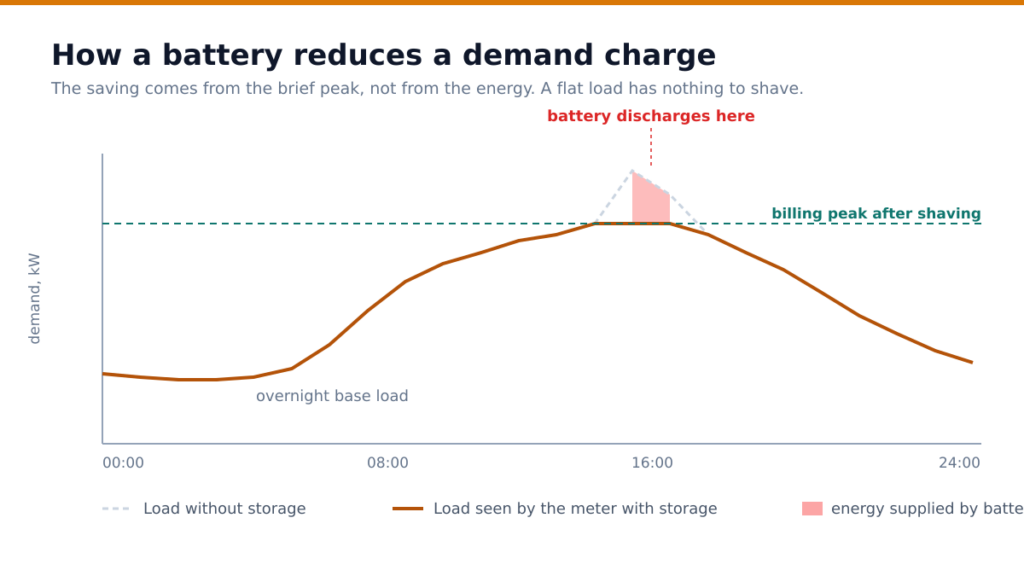
Many commercial tariffs charge for the highest short interval of demand in the billing period as well as for total energy. A battery can discharge during those brief peaks, lowering the recorded maximum. This is the most common economic justification for commercial storage and the one most likely to produce a real return, because the saving is large relative to the energy moved.
It depends entirely on the shape of the load. A facility with occasional sharp spikes against a modest baseline is an excellent candidate, because a small battery can shave a lot of demand. A facility running flat out all shift has almost no peak to shave, and storage will do little for the demand charge no matter how large it is.
Time of use arbitrage
Where tariffs price electricity differently by hour, a battery can store cheap or self generated energy and discharge it during expensive periods. The value of this depends on the spread between peak and off peak rates. A wide spread makes it worthwhile. A narrow one does not, because every cycle involves round trip losses and consumes a share of the battery’s finite cycle life.
Resilience
This is what most clients mean when they ask about batteries. A standard grid tied solar array shuts down during an outage, by design, so that it does not energise lines that utility crews believe to be dead. Backing up a facility requires storage plus switching equipment capable of forming an island, and it requires decisions about which circuits are supported and for how long.
Resilience is a legitimate reason to buy a battery and a poor reason to expect a financial return. The value is the avoided cost of an outage, which for a cold store, a laboratory or a data room may be enormous and for an office may be close to the cost of sending people home. Organisations should price it as insurance rather than as an investment.
Sizing, and why power and energy are not the same
A battery is described by two numbers that people routinely conflate. Power, in kilowatts, is how fast it can charge or discharge. Energy, in kilowatt hours, is how much it holds. The ratio between them determines what the battery is good at.
Demand charge management needs power, because the task is to cover short sharp peaks. A high power battery with modest energy capacity does this efficiently. Backup supply needs energy, because the task is to sustain load for hours. The same investment configured for one purpose will perform the other badly.
This is why the load analysis comes before the quotation. Interval meter data showing demand in short increments across a full year reveals the shape of the peaks, their duration and their timing. Without that data, any sizing recommendation is a guess dressed as engineering.
The costs that extend beyond the battery
The cells are only part of the installed price. A storage installation includes the enclosure, the power conversion system, thermal management, fire detection and suppression appropriate to the chemistry, switchgear, controls and often a building modification to house it. Codes governing indoor battery installation have become considerably more prescriptive, and the room may need separation, ventilation and detection that a plant room does not currently have.
Then there is degradation. Batteries lose capacity with cycling and with age, and a system sized precisely for today’s peak will shave slightly less each year. Warranties typically guarantee a retained capacity after a defined number of cycles or years, and that figure, not the nameplate, is what the later years of the financial model should use.
Control software is also a recurring cost in many arrangements, and it matters more than its price suggests, because the savings depend on the controller correctly predicting when to discharge. A battery that discharges too early and sits empty when the real peak arrives has achieved nothing.
Where storage genuinely pays today
The clearest cases share features. A tariff with a substantial demand charge component. A load profile with pronounced, short, predictable peaks. A wide time of use spread. Available incentives specific to storage, which exist in several states and have at times been generous enough to change the answer by themselves. And a facility where an outage carries real cost, so that resilience value can be counted alongside the tariff savings rather than instead of them.
Where none of those features is present, the honest recommendation is often to install solar without storage now and revisit storage when tariffs, costs or incentives change. Designing the array with a sensible route to later integration costs very little and preserves the option.
Whatever the configuration, the project should be evaluated with the same discipline as any other, separating energy savings from demand savings in the way our note on how commercial solar payback is actually calculated sets out, and it will only deliver as modelled if somebody is watching the output, which is the subject of our piece on monitoring solar production and spotting underperformance. General technical background is summarised in the overview of battery energy storage systems.
Frequently asked questions
Will solar alone keep my building running in an outage?
No. A standard grid tied array shuts down when the grid fails. Backup requires storage together with switching equipment capable of operating as an island.
What size battery do I need?
It depends on the purpose. Peak shaving needs power capability, backup needs energy capacity, and the sizing should follow from interval meter data rather than from a rule of thumb.
Does storage pay for itself?
Sometimes, where a tariff has a significant demand charge and the load has sharp predictable peaks, or where a wide time of use spread exists. Resilience value is real but should be treated as insurance rather than return.
How long does a battery last?
Capacity declines with cycling and age. Warranties state a retained capacity after a defined period or cycle count, and that figure rather than the nameplate belongs in the later years of a financial model.
Can storage be added to an existing solar installation?
Usually yes, though it may require changes to inverters, switchgear and controls. Allowing for it at the design stage makes later addition considerably simpler.