Solar arrays fail quietly. A motor that seizes announces itself, but a photovoltaic system that loses a tenth of its output carries on looking exactly the same from the car park. The only way anyone finds out is through monitoring, and the uncomfortable truth about commercial solar is that a great many systems are monitored in the sense that data is collected and nobody looks at it.
What gets measured and at what level
Monitoring happens at three levels of granularity, and which one you have determines what you can detect.
System level monitoring reads total output at the point of connection. It is the cheapest arrangement and tells you only that the system as a whole produced a certain amount. A single underperforming string within a large array can hide inside normal variation for a long time.
Inverter or string level monitoring reports output per inverter or per string. Because strings in the same orientation should behave almost identically, comparing them against each other is a powerful diagnostic. A string producing noticeably less than its neighbours is a fault, and you do not need to know anything about the weather to conclude that.
Module level monitoring, available where optimisers or microinverters are installed, reports each module individually. It localises faults precisely and costs more in both hardware and data handling. For large commercial arrays, string level comparison usually gives most of the diagnostic value for a fraction of the complexity.
The measurement that makes the rest meaningful
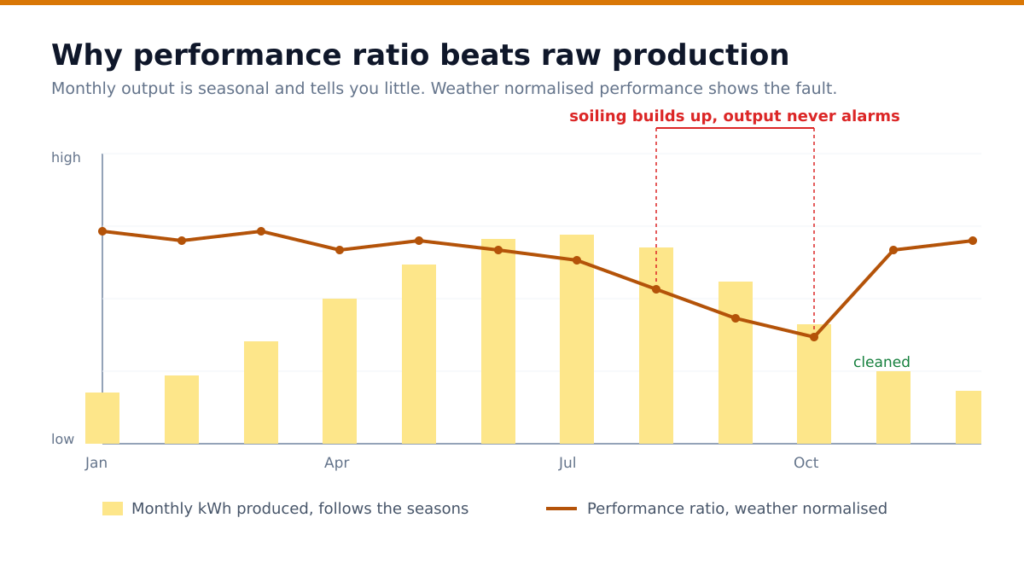
Raw production in kilowatt hours tells you very little, because output depends on sunshine. A low month may mean a fault or may mean cloud. Distinguishing the two requires a reference.
The usual reference is irradiance measured on site with a pyranometer in the plane of the array, combined with module temperature. From these you calculate a performance ratio, the relationship between what the system produced and what it theoretically should have produced given the conditions it actually experienced. Performance ratio is weather normalised, so a decline in it is a genuine signal rather than a seasonal artefact.
Systems without on site irradiance measurement can use satellite derived data, which is adequate for detecting large problems and too coarse for detecting small ones. For a system of meaningful size, a sensor is a modest cost that makes every other measurement interpretable.
What underperformance usually turns out to be
Soiling is the most common and the most reversible. Dust, pollen, agricultural deposits, salt near coasts and bird droppings all reduce transmission. In climates with regular rainfall the effect is self limiting. In dry or dusty environments it accumulates until someone washes the modules.
Shading that was not in the original model is the second. Vegetation grows, neighbours build, and rooftop mechanical equipment gets replaced with something taller. Shading faults have a characteristic signature, appearing at consistent times of day and shifting predictably with the season.
Inverter issues are the third and the most consequential. Inverters are the shortest lived major component in a photovoltaic system, and a tripped or derated inverter can take a large block of capacity offline. Clipping, where the array produces more direct current power than the inverter can convert, looks like a flat ceiling on bright days and may be a design decision rather than a fault.
Then there are string level faults from connector failure, water ingress or blown fuses, and gradual module degradation, which is expected and slow. Degradation only becomes a warranty matter when it runs well ahead of the manufacturer’s published curve, which is something only multi year records can demonstrate.
Alarms that people actually respond to
A monitoring platform that sends an email every time a cloud passes trains its recipients to ignore it. Useful alerting is specific and tolerant. Reasonable rules include a string producing below a defined fraction of its peer average over several days, performance ratio falling below a threshold on a rolling average, an inverter reporting zero output during daylight, and communications loss from the data logger itself.
That last one matters more than it sounds. A system that stops reporting is indistinguishable from a system that is fine, and a logger that has been offline for four months has concealed whatever happened during those four months.
Somebody has to own it
The most common failure in commercial solar monitoring is organisational rather than technical. Nobody is named. Under a third party ownership arrangement, responsibility usually sits with the owner and should be written into the agreement, including a response obligation rather than merely a monitoring obligation. Under direct ownership, it belongs to a named person in the facilities function with a defined review interval.
Building a record that is worth having
Keep monthly production alongside weather normalised performance ratio, and keep it for the life of the asset. That record is what supports a warranty claim, what informs the decision about when to replace inverters, and what a buyer will ask for if the building or the project ever changes hands. A system with ten years of clean performance data is a more saleable asset than an identical one without it.
It also closes the loop on the assumptions that justified the project in the first place. The production estimate and performance ratio that appeared in the original financial model, discussed in our note on how commercial solar payback is actually calculated, can finally be tested against what the array actually did. Technical background on system components is summarised in the overview of photovoltaic systems.
Frequently asked questions
Is module level monitoring worth the extra cost?
For large commercial arrays, string level comparison usually captures most of the diagnostic value for considerably less cost and complexity. Module level monitoring is most useful on complex roofs with unavoidable partial shading.
Why is a performance ratio better than kilowatt hours?
Because it accounts for the sunlight and temperature the system actually experienced. A fall in production may be weather. A fall in performance ratio is a fault.
How often should modules be cleaned?
It depends entirely on the environment. In climates with regular rain, rarely. In dry, dusty or agricultural settings, cleaning may be worth scheduling, and monitoring data showing a gradual decline that reverses after rainfall tells you whether it pays.
What is clipping and is it a problem?
Clipping happens when the array generates more direct current power than the inverter can convert, producing a flat ceiling on bright days. Modest clipping is often a deliberate and economically sound design choice.
Who should be responsible for responding to alarms?
A named person or party with a defined response obligation. Under third party ownership this should be a contractual duty of the owner, not merely a promise that monitoring exists.