Before anybody talks about modules or inverters, somebody has to climb onto the roof and find out whether it can take an array at all. The roof assessment is the least glamorous stage of a commercial solar project and the one that most often determines whether it proceeds, gets redesigned or quietly dies. A buyer who understands what the assessment covers can tell a thorough survey from a sales visit with a tape measure.
Remaining service life, the question that comes first
A photovoltaic array is designed to sit in place for twenty five years or more. A commercial membrane roof may have anywhere from two to twenty five years of life left. If the roof will need replacing well inside the life of the array, the array must come off and go back on, and that cost is large enough to change the economics of the whole project.
The assessment should therefore establish the roof type, its age, its warranty status and its observed condition. Membrane roofs are inspected for shrinkage, seam integrity, blistering, ponding and prior patch repairs. The honest outcome is sometimes that the sensible sequence is to reroof first and install second, bundling both into a single capital request.
Structural capacity
Modules, racking and ballast add weight. A ballasted system, which holds itself down with concrete blocks rather than penetrating the membrane, adds considerably more dead load than an attached one. In regions with meaningful snow loading the governing case is usually the combination of array weight and accumulated snow, and drifting against rows of modules can concentrate load in ways a flat roof never saw before.
This is engineering work, not estimation. A structural engineer reviews the original framing drawings where they exist, verifies members in the field where they do not, and signs off on the proposed loading. Where capacity is marginal, the answer may be a lighter attached system, a reduced array footprint, or localised reinforcement.
Attachment strategy and the roof warranty
Attached racking penetrates the membrane and must be flashed to the standards of whoever holds the roof warranty. Ballasted racking avoids penetrations but relies on weight and friction, which brings wind uplift into the calculation. Neither approach is universally better, and the choice follows from the roof construction, the structural margin and the wind exposure of the site.
The warranty question deserves a direct answer in writing. Many manufacturers will maintain a membrane warranty through a solar installation provided their approved details and sometimes their approved contractor are used. Finding this out after installation is a poor way to discover it.
Shading and the geometry of the roof
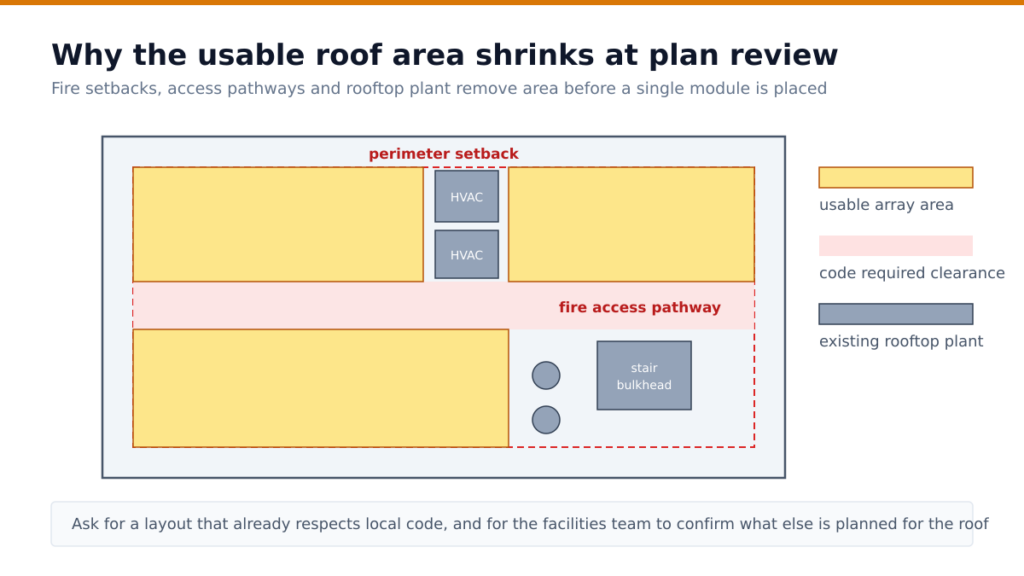
A commercial roof is rarely an empty plane. Parapets, mechanical units, exhaust vents, stair bulkheads, satellite dishes and adjacent taller buildings all cast shadows that move through the day and through the year. Shading analysis models those shadows across seasons rather than at a single moment, because a vent that is harmless in June can clip a row of modules through a winter afternoon.
Row spacing follows from the same geometry. Tilted rows shade the row behind them at low sun angles, so there is a trade between packing modules densely and losing winter production to self shading. The assessment should state the assumed tilt, the row pitch and the resulting ground coverage ratio.
It should also record what the client intends to do with the roof later. A chiller replacement, a new make up air unit or a planned rooftop amenity area all change the usable area, and the only person who knows about them is the facilities manager.
Access, safety and setbacks
Fire codes and local amendments typically require clear pathways and perimeter setbacks so that firefighters can move across a roof and ventilate it. These requirements remove usable area, sometimes a substantial share of it on a small or awkwardly shaped roof, and they are not negotiable. A layout drawn without them will shrink when it reaches plan review.
Practical access matters too. How equipment reaches the roof, whether a crane is needed and where it can stand, where the inverters and switchgear will sit, and how the direct current and alternating current runs reach the point of interconnection without crossing the roof in ways that complicate future maintenance.
The electrical side of the survey
The array has to connect to something. The assessment examines the main service, available panel capacity, the rating of the switchgear and whether an interconnection can be made within the limits that apply to the existing equipment. A service that is already near capacity may need upgrading, and a service upgrade can be a larger line item than a meaningful share of the array itself.
Metering arrangements, utility requirements for visible disconnects and the physical route for conduit all belong in the same review. General background on how these components fit together is set out in the solar technologies resources published by the Department of Energy.
What a good report looks like
A sound assessment produces a document, not a verbal reassurance. It states the roof type, age, warranty position and condition with photographs. It records measured dimensions and obstruction locations. It includes a shading study across the year. It carries a structural opinion from a qualified engineer. It names the attachment method and the reason for it. It shows a layout that already respects fire setbacks. It identifies the interconnection point and any service limitations. And it lists the assumptions it could not verify, which is the part that separates a professional survey from an optimistic one.
The production estimate that comes out of this work feeds straight into the financial model, which is why the two should be read together rather than separately. The assumptions behind that estimate are exactly the ones discussed in our note on how commercial solar payback is actually calculated.
Frequently asked questions
How much roof life should remain before installing an array?
Enough that the roof will not need replacing inside the array’s service life. Where the margin is thin, reroofing first and installing afterwards usually costs less than removing and reinstalling modules later.
Does a solar installation void a roof warranty?
Not automatically. Many manufacturers maintain coverage when their approved details and sometimes their approved contractors are used. Get the position confirmed in writing before work starts.
Is ballasted racking better than attached racking?
Neither is universally better. Ballast avoids membrane penetrations but adds weight and brings wind uplift into play. Attachment is lighter but requires flashed penetrations. The roof construction and wind exposure decide.
Why does the usable area shrink after plan review?
Usually because fire access pathways and perimeter setbacks were not included in the initial layout. Ask for a layout that already reflects local code requirements.
Can the electrical service limit the system size?
Yes. Available capacity in the existing switchgear and service often caps the array before the roof area does, and a service upgrade can be a significant additional cost.